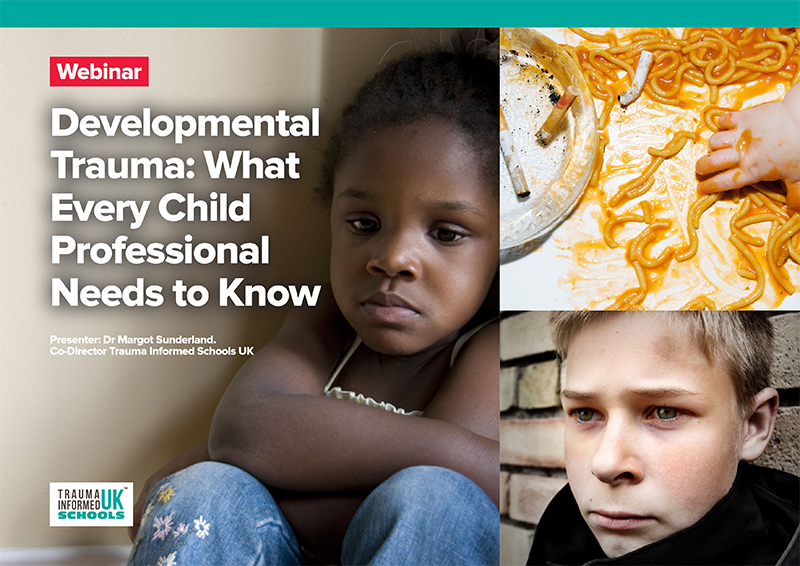
The webinar starts by exploring how child maltreatment impacts on the brain. Dr Sunderland then addresses the key components of developmental trauma ( DT) including poor emotional regulation, cutting off from vulnerable feelings, blocked trust, seeing relationships as being about power and control, very low self-esteem and dissociation as a defence against unbearable pain. She explores how DT is an interpersonal trauma, involving major disruption to the attachment relationship. From this, she goes on to consider what needs to happen in current and future key relationships in the child’s life in order to bring about secure attachment, often for the first time. In detail, she addresses how emotionally available adults need to be with these children and specifically how to respond in moments of intense emotion and with behaviours that challenge. In summary, Dr Sunderland explains how to relate to these children so they can heal, whilst ensuring that others (e.g., schools) are made aware of their special emotional needs that must be responded to.
Click the play button to purchase.
Presenter: Dr Margot Sunderland
(Please note this webinar includes some film footage that some viewers may find particularly distressing.)
This webinar is essential viewing for anyone working or living with children/young people who have experienced abuse or neglect
Firstly, Dr Sunderland will define what is meant by developmental trauma. She will then explore how it impacts on the brain leaving a whole raft of blocks to quality of life, e.g., compromised reward processing system, memory processing system and over-active threat response system in the brain, poor emotional regulation, blocked trust, seeing relationships as primarily being about power and control, low self-esteem and dissociation and re-victimisation as a defence against unbearable pain.
Dr Sunderland then discusses key relational interventions vital for recovery and also to support the process of repair in the brain (known as neuroplasticity and neurogenesis). She addresses how emotionally available adults need to be with these vulnerable children and specifically how to gain their trust and how to respond to times of intense emotion and to behaviours that challenge. She will argue that its vital for foster carers, adoptive parents and schools to be made aware of the very particular unmet emotional needs in these children and will discuss how to meet those needs.
What you will gain from viewing:
| Part | Cost |
| Full Webinar: |
£229 for 2 months access |
Running time
Part one / two: 1 hr 58 mins
Company Registration 11457893
WELLMINDS UK LIMITED
Palladium House, 1-4 Argyll Street,
London, United Kingdom, W1F 7LD

 |
 |
 |
 |
 |
 |
||||
